

Ronan Lima builds bridges between racial and climate justice

Ronan Lima
Photo: Personal Archive
Recognizing the many ways of “being a believer” is a fundamental starting point for building narratives capable of connecting with the diverse contexts and lived experiences of faith communities. In this regard, engaging Black Brazilians, who make up 61% of Brazilian evangelicals, according to the 2022 Census, becomes essential to opening meaningful pathways for dialogue with this segment.
For Ronan Lima — coordinator of the Martin Luther King Jr. Program of the Black Evangelical Movement (MNE, the acronym in Portuguese), pastor, and holder of a master’s degree in Theology from PUC-Rio — the multiple layers that shape these agendas generate bonds of belonging and open up a range of solutions and pathways toward another Brazil. A Brazil that can look to the organization of Black communities within churches as one of the routes for strengthening a democratic culture, advancing human rights, and upholding a secular state that guarantees pluralism in all its dimensions.
For Ronan, the importance of churches extends far beyond any label applied from outside faith communities. “They function as centers for restoring dignity. They are spaces where many Black people have the opportunity to develop fully, without being seen solely as cheap labor,” he reflects. He adds that Black evangelicals make up a significant share of the Brazilian population.
“The majority are women from the urban outskirts, who take on the work of collective care within their congregations and the communities where they live. Speaking to evangelicals therefore means speaking to Black people who, even without full racial consciousness, understand that they are perceived differently. When Black evangelicals denounce the racism they experience, including within institutions considered conservative, the discourses that emerge from this stance help build justice and reparation within the realm of faith, becoming an entry point for broader and more positive social transformations in the country.”
Seeing Black theology as a vital tool for this social transformation and for strengthening Black evangelical leadership, the MNE has, in recent years, dedicated itself to expanding its presence and circulation as a perspective in Brazil. “We have consistently taken on a catalytic role in popularizing and producing Black theology in Brazil, encouraging people to pursue formal study and academic theology, while the theology produced in communities, in liturgies, and in everyday life continues to flourish, and new ways of worshipping and seeing the world are being replicated by Black evangelical leaders,” he explains.
He notes that these actions help more people within the churches develop a consciousness of racial justice - a consciousness directly tied to building a more diverse and equitable country.
“It is a way of broadening the understanding of racism as a wound deeply rooted in Brazil’s social formation, showing its connection to the need to fight for justice, reparation, and good living (bem viver), while also linking this struggle to respect for diverse religious traditions.”
In addition to efforts aimed at promoting antiracist practices within and beyond church life, the MNE also works to mobilize evangelical communities to engage with climate justice and to understand the political dimensions of the catastrophes and emergencies that define this agenda. According to Ronan, this work unfolds through projects designed to be replicated in churches. “In 2024, we launched the ‘Acácias’ project, an initiative that fostered debate on climate and environmental racism through activities involving 15 young people over eight months, in a process structured in three stages: training, multiplication, and public advocacy.”
The project also included a training program for religious leaders at the National Center for Monitoring and Early Warning of Natural Disasters (CEMADEN) and at the National Institute for Space Research (INPE), creating a space for dialogue between pastors and scientists aimed at confronting climate denialism and raising awareness among these leaders. The initiative brought together people with different perspectives, including both more conservative and more progressive profiles, in the same room.
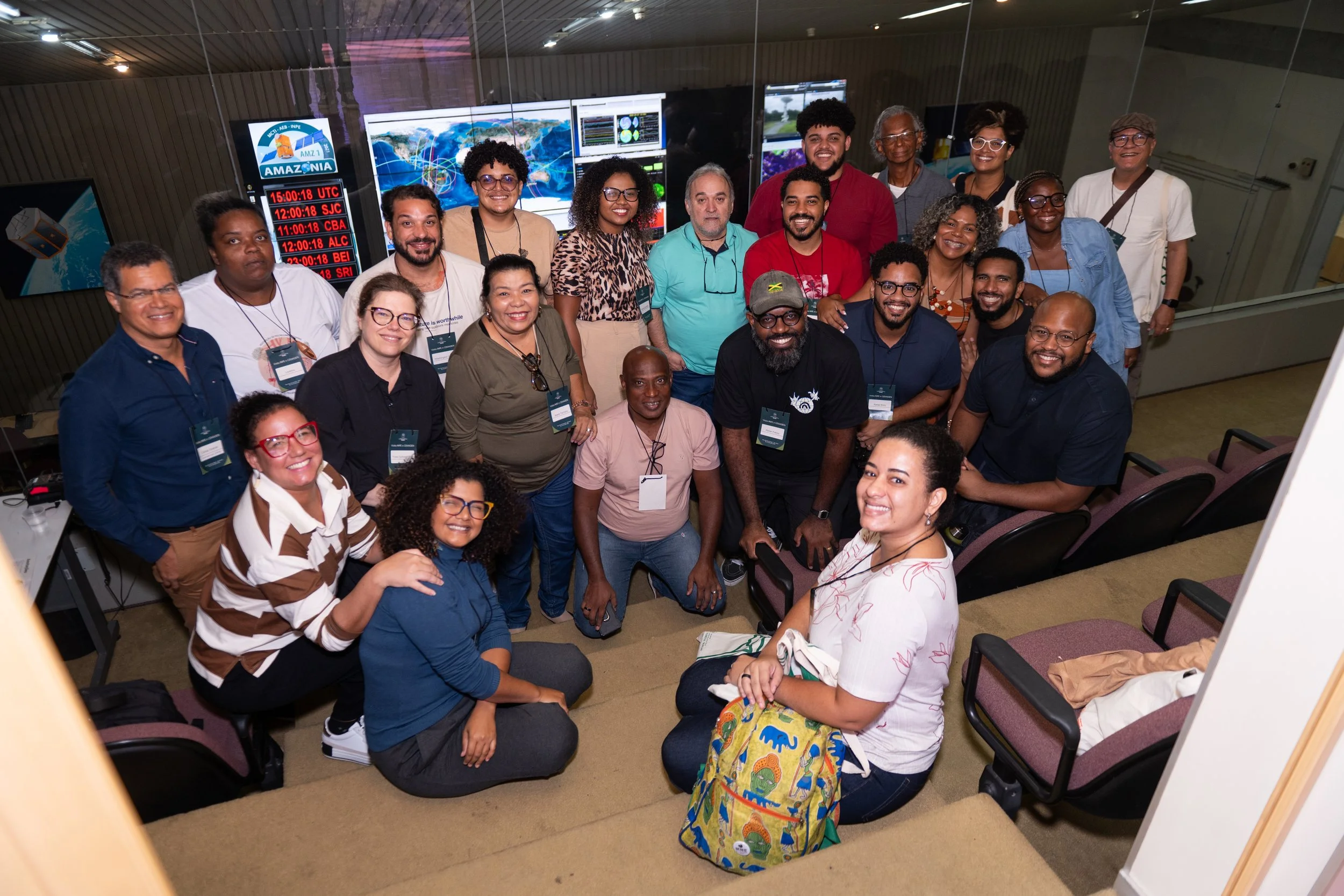
Young people, faith leaders, and members of Movimento Negro Evangélico (MNE) during an immersion program at CEMADEN.
Photo: Institutional archive
He explains that, in the multiplication stage, participants were responsible for bringing the knowledge they had acquired back into their own social circles. “The idea is to do this creatively. The testimonies we collected, describing what it was like to take these discussions into their own communities, caught our attention and strengthened our sense of hope,” he says.
Ronan notes that, since the “Acácias” project, the MNE has deepened its commitment to the climate agenda. “This approach gained momentum when we decided to expand our presence in networks of climate organizations and to communicate our message more publicly, connecting climate issues with faith communities.”
He highlights that there are already concrete examples of this growing engagement. “We carried out the campaign ‘Nossa fé move montanhas, não as destrói’ (‘Our faith moves mountains, it doesn’t destroy them’) and, in the lead-up to COP30, we promoted climate discussions involving churches and local leaders through training sessions, moments of prayer, and awareness-raising activities on environmental issues within participants’ own territories.”
The MNE is now preparing a 2.0 version of the “Acácias” project. “Our idea is to relaunch the project as a fellowship, continuing the campaign and aiming to further strengthen the climate debate within evangelical spaces,” he explains. He emphasizes that it is essential for people to see themselves as part of the problem, but also part of the solution.
Ronan adds that there is room, within churches, in society at large, and in dialogue with public authorities, to demonstrate that faith communities can be part of the solution, especially since many of them already practice, in their daily lives, actions aligned with these commitments. What is missing, he notes, is the ability to recognize themselves in this role.