

Luciana Petersen and the common ground faith communities create in Brazil

Luciana Petersen
Photo: Tatiane Nuvolari
In what she describes as "finding church with other people," journalist, pastor, Black feminist, progressive Christian, and holder of a master's degree in Digital Communication and Data Culture from FGV, Luciana Petersen found a home in Novas Narrativas Evangélicas. The initiative works to shape the ongoing dispute over evangelical identity through concrete actions and forward-looking agendas grounded in human rights and directly connected to core themes of evangelical faith and to Brazil’s most pressing social challenges.
When discussing how Novas Narrativas Evangélicas has, in practice, worked to shape an anti-fundamentalist* evangelical agenda, Luciana highlights the movement’s investment in affective languages and formats. It is an agenda that also emerges from an evangelical experience committed to life-affirming policies and social justice. “We start from this path to raise issues of racial and gender justice, climate action, LGBTQIA+ rights, and democracy,” she says.
Novas Narrativas Evangélicas reaches audiences including young evangelicals, LGBTQ+ people, and Black women. According to Luciana, this creates room for working with a more engaging and innovative language. At the same time, it also generates resistance within the evangelical field itself, which at times associates the movement with stereotypes or considers it “too forward-leaning.”
Reflecting on how to navigate between these extremes while still maintaining a commitment to democracy and human rights and producing strategic reflections capable of mobilizing evangelicals as well as broader sectors of Brazilian society, Luciana notes that there is a large group situated between the poles. “These are people who are neither rooted nor mobilized. A large part of the evangelical population is not polarized, but inhabits churches, the streets, and the internet with questions about faith, life, and society. Our goal is to be a strong counterpoint to religious fundamentalism and to establish strategic dialogues with broad fields,” she says.
In this sense, Novas Narrativas Evangélicas works through a range of communication strategies. “We develop a variety of products, from memes to music, devotionals, and political education gatherings.We believe we can promote new narratives, including among audiences who disagree with our agendas, grounded in the shared foundation of the faith that unites us.”
This need to develop a variety of formats to engage these audiences also appears in media outlets that do not work exclusively with faith communities. The evangelical segment is increasingly present in soap operas, series, films, and podcasts. Looking at the current landscape, in which this audience has become central in the broader dispute over narratives, Luciana argues that the portion of the population consuming these products should not be approached through a logic of taboo.
“Being evangelical is already part of Brazil’s culture, and this needs to stop being treated as a taboo. We are dealing with a complex culture that is constantly expanding and encompasses a large share of the population in its expressions of music, literature, art, fashion, dance, food, sports, behavior, and entertainment. We need to learn to see the beauty in that.”
For Luciana, the difficulty some sectors of society have in recognizing the evangelical population as part of Brazil’s cultural fabric is directly tied to a long history of caricatured and prejudiced media portrayals. “There is a history of representations that depict these people as alienated, unintelligent, and disconnected from the world. It is essential to recognize the shift taking place in narratives about the evangelical segment, with more humanized portrayals that are faithful to this portion of the population - a population that is working-class, predominantly Black, female, and from the urban outskirts,” she says.
She adds that this is a plural group that consumes culture, faces everyday social challenges, and influences electoral outcomes. “Engaging this segment of the population on civic issues, using the language and the emotional registers that mobilize them, is extremely strategic for advancing a more democratic and inclusive Brazil.”
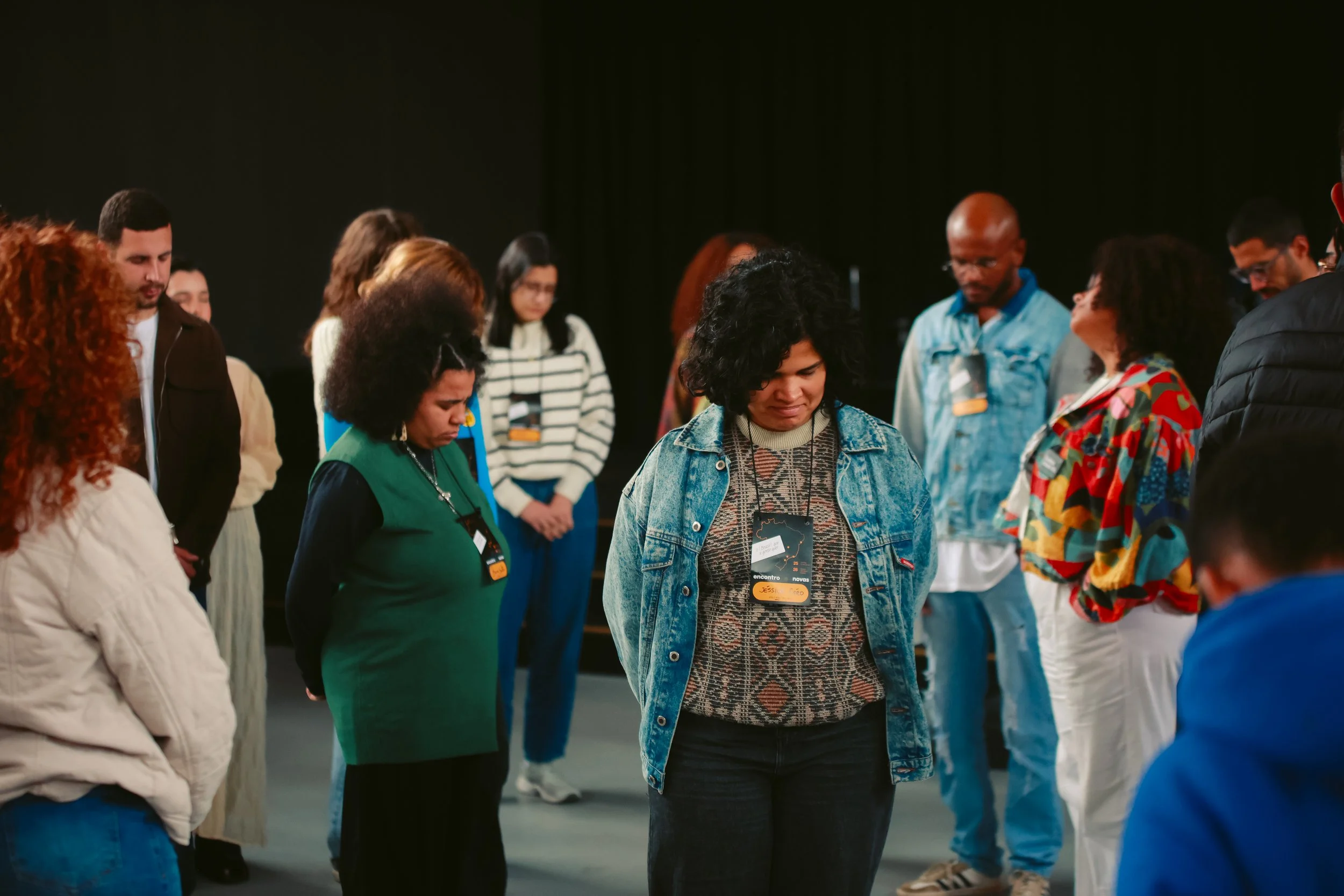
Participants during an activity by the Novas Narrativas Evangélicas Movement
Photo: Rafael Brito
When reflecting on the pathways for engaging this audience and on what it means to “be evangelical” within the context of new narratives, Luciana argues that the starting point is recognizing that being Christian is a way of being and inhabiting the world. “Following in the footsteps of Jesus, a teacher who establishes an ethic of radical love and fundamental values for a life that makes sense both here and in eternity,” she says. She adds that the book that grounds this vision is, at the same time, a text under dispute.
“Evangelicals regard the Bible as a sacred book - one that tells the story of a people who walk with God and inspires us to seek a meaningful existence in this life while longing for an eternity without death or pain. Yet the Bible is a contested text and has been historically co-opted to justify oppression, violence, and projects of power that have nothing to do with the Gospel (the ‘good news’) of Jesus.”
According to Luciana, in recent years Brazil has witnessed a direct expression of this dispute through the rise of more extreme positions within parts of the churches. “This led to an intense radicalization of some segments of this population and to a mass exodus from churches among those who do not agree with the instrumentalization of faith,” she explains. She adds that developing new narratives must take scenarios like this into account.
“Thinking about new narratives in this context means confronting what religious fundamentalism asserts as truth about our faith, affirming thatthere is no single story about being evangelical in Brazil and that there are many ways of being a believer. We are many, with diverse experiences and bodies. We are not detached from Brazil’s social problems - we feel society’s oppressions in our own skin and mobilize to change the world through our faith.By advancing new narratives, we inhabit the cracks of oppressive systems, believing that it is possible to live a faith and a spirituality grounded in justice, diversity, and collective dreams,” she concludes.
*Religious anti-fundamentalism refers to positions, initiatives, and perspectives that oppose the use of rigid or exclusivist religious interpretations to restrict rights, limit freedoms, or shape public policy in exclusionary ways. The term does not refer to opposition to religion itself, but rather to the defense of religious pluralism, the secular nature of the State, and democratic coexistence.