

Relearning the future: culture, climate, and lessons from the Amazon

Jeft Dias
Photo: Hilton Naka
With Belém hosting the 30th United Nations Climate Change Conference in 2025, the connection between culture and climate has become impossible to ignore. When culture intersects with the climate agenda, it can spark critical reflection grounded in people’s lived experiences. In that space, culture becomes a powerful arena for shaping narratives.
For Jeft Dias, cultural producer, creator, and director of Instituto Psica, which organized several activities during COP30, culture is one of the most powerful ways to draw attention to the climate agenda. “We need creative and competitive ways to alert people to the risks to our survival that the absence of climate debate can cause. This is where culture can act effectively, especially when the strategy recognizes that our people express their attachment to territory through culture,” Jeft says. He adds that when work is done to strengthen this bond, the chances of capturing people’s attention and encouraging them to reflect on how the climate emergency affects care for the territory increase.
To mobilize people around agendas like the climate agenda, Psica invests in expressions such as audiovisual storytelling. “We start from stories told in urban outskirts and in rural areas of the northern states of Brazil. From them, we produce films, curate musical events, and create content for social media to raise awareness among our audience about socio-environmental issues, working with the sense of belonging and the emotional memory everyone has of the culture produced in our territory.”
Psica’s commitment to and celebration of the territory is longstanding. Led by Jeft alongside his brother, Gerson Junior, the Institute is also a production company, a locally-rooted cultural movement, and a festival that has become one of the main independent music events in Brazil and was declared Intangible Cultural Heritage of the Municipality of Belém by the City Council. Jeft explains that the word psica comes from Nheengatu, a language derived from Tupinambá and spoken throughout the Brazilian Amazon, and means “to catch.” “It’s as if you were saying that something will catch onto you and won’t let go - and that can be either good or bad,” he explains.
Over time, and under the influence of the colonization process, the term became more closely associated with negativity. “People say that the more you repeat the word psica against an opponent, the more that opponent can be struck by it, missing a move, having bad luck, and so on. When we created the Institute, we reclaimed the term, because for us psica is a decolonial battle cry, an ancestral weapon against the injustices we have historically faced. Those who fear psica know exactly why they fear it.”
This battle cry has echoed for more than 13 years through projects that rescue, elevate, and rewrite the cultural, social, political, and environmental identity of the Pan-Amazon region.
So when Belém was chosen to host COP30, the brothers were more than ready to connect their projects, actions, and events to the conference.
Psica deepened its connection with the territory when it created Casa Dourada, a “cultural apparatus” that reclaims a history predating colonization and expands the social work the Institute was already doing in Pará. Jeft explains that the initiative represents an expansion of the impact they sought to generate in the territory, since it offers active programming throughout the year. “The goal is to have the Psica Festival serve as a major draw to Casa Dourada, where we carry out various actions for cultural strengthening, climate debate, technical training, and cultural production. The two projects feed into each other, strengthening the state’s creative economy ecosystem,” he says, adding that the Casa carries Psica’s DNA. “The Casa has the same purpose of strengthening the culture of Pará and the North region, with a focus on peripheral, Black, Indigenous, and LGBTQIAPN+ youth. It is a permanent space that welcomes and trains people from the urban outskirts and also serves as a year-round stage for emerging artists.”
Using this entire “cultural apparatus,” with deep knowledge of the region and now with a focus on the COP30 period, brothers Jeft and Gerson prepared a special program for the days of the conference. “We defined a theme for the program together with Instituto Regatão and then hired PEP Consultoria to develop and execute our proposal, which resulted in a curatorial concept that identified fair financial distribution as the main point of tension at the conference and warned about the prioritization of individual interests over our collective future,” he says. He adds that, as a curatorial hypothesis, Casa Dourada followed three pillars: territory as climate intelligence; affection as political language; and memory as the code of tomorrow, positioning Amazonian culture as a “transition technology.”
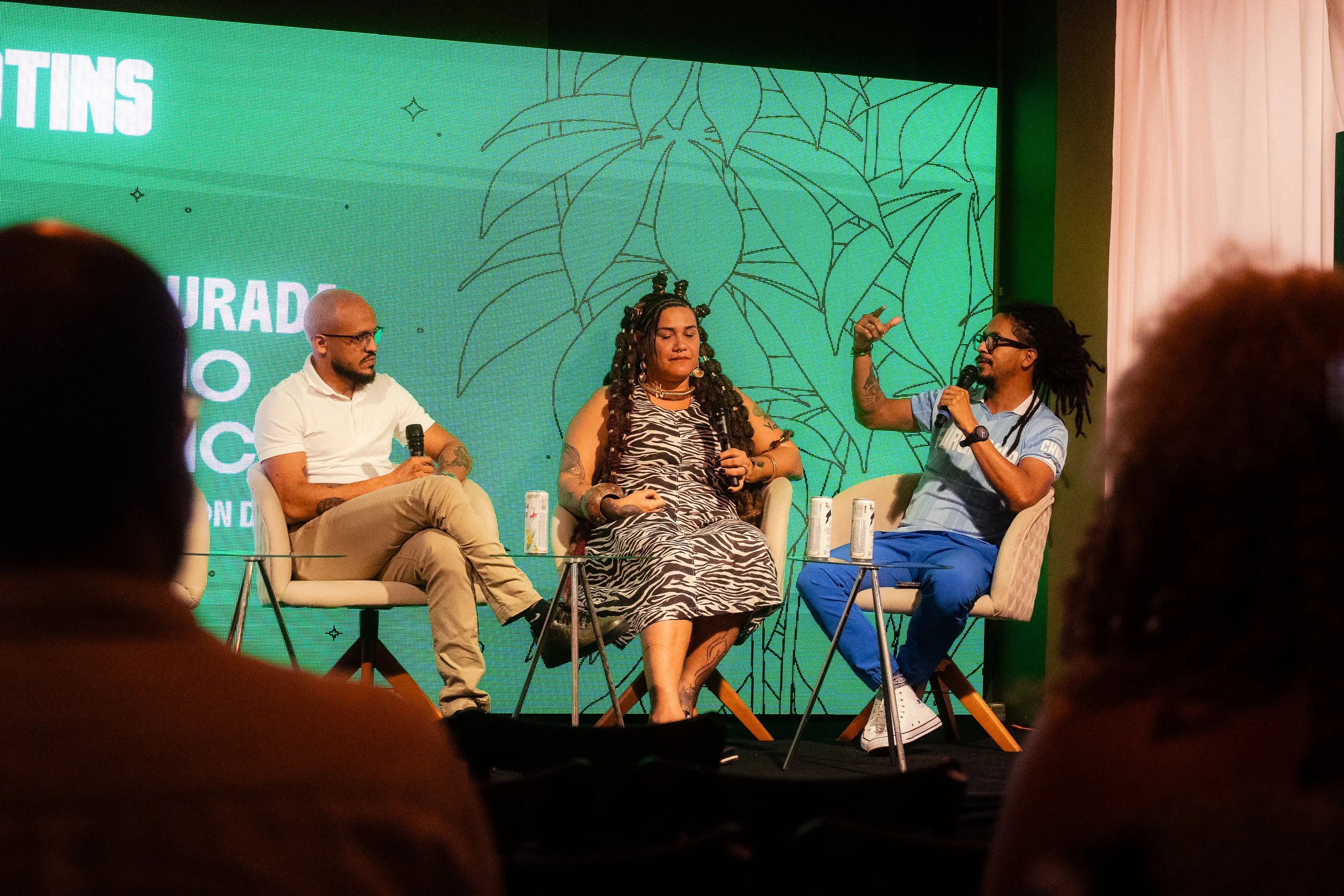
Gerson Dias, Bruna Suelen, and Jeft Dias, from Psica Produções, during the panel “The Return of the Dourada: the end and the beginning of a new cycle”
Photo: Wagner Filmes
“In a collapsing planet, the curatorial proposal took shape by looking at Amazonian cultural practices - celebrations, affections, cosmologies, meanings, and forms of resistance - not as symbols of a past, but as living infrastructures of the future,” Jeft notes, emphasizing that at the COP, Casa Dourada was less a stage and more a collective body. “A place where art, politics, and culture came together to relearn the future. A learning rooted in Amazonian peoples, who for generations have rehearsed ways of living with the forest, with time, and with one another. Their cultures are devices of care, economy, and imagination that already respond to the crisis the world is still struggling to name.”
During COP30, with brands interested in the territory and global leaders, Jeft explains that they were able to draw the attention of these actors and of the audiences they engage with, reinforcing the importance of investing in initiatives that continue to generate impact in the city after the conference. “We managed to establish contact with several brands, and some were essential for Casa Dourada to gain visibility and remain active for a period,” he says, noting, however, that a challenge has emerged now that the spotlight has faded. “The immediate challenge is securing resources to give the project greater longevity.
Strengthened by the heightened visibility it gained after COP30, the Casa will continue hosting exhibitions from the urban outskirts of the Amazon regions, courses, musical performances, film screenings, and activations dedicated to debating ideas with socio-environmental and cultural impact.